
Pharma Transformation · Part 1 of 2
Supercharge Pharma Operations with AI
How generative AI in pharma operations teams up with MLOps and DataOps to defragment commercial functions, unlock omnichannel HCP engagement, and add value.
In my recent mini-series on fragmentation in healthcare and pharma, we explored the challenges that siloed data and disconnected systems pose to efficient operations and decision-making. Now, let's dive deeper into how emerging technologies like generative AI in pharma operations drive digital transformation, particularly in commercial operations, by fostering collaboration and providing real-time insights across organizations.
The potential to revolutionize the commercial model is immense, but so are the challenges. With over two decades in digital healthcare, I've witnessed many tech shifts, but today's AI revolution stands out as far more transformative than any before.
Then → now. When I first published this piece, generative AI in pharma was largely a slide-deck promise: pilots, proofs of concept, and a lot of "we're evaluating." By 2026 the picture has flipped. Agentic AI and far more capable models have moved from the lab into day-to-day commercial workflows, and the gap between the companies that built the data and governance foundations early and those that didn't has widened sharply. The exponential pace is the story: the same $18B–$30B opportunity McKinsey sized is now being actively captured, not just modelled, and the cost of waiting compounds every quarter. Everything below still holds; the urgency has only increased.
Unlocking AI's Full Potential: From Fragmented Data to a Connected Foundation
Bear with me as we dive into some technical background, don't worry, I promise to keep it interesting. While generative AI grabs headlines like a celebrity on the red carpet, its true superpowers are unleashed when it teams up with MLOps and DataOps: think of them as the dynamic trio of the digital transformation world.
MLOps, or Machine Learning Operations, ensures that AI models are developed, deployed, and monitored efficiently. It fosters collaboration between data science and IT teams, streamlining the machine learning lifecycle for faster iterations and improved model performance (Google Cloud, 2024).
DataOps (Data Operations), on the other hand, applies agile methodologies to data management, breaking down silos and enhancing data quality. It promotes seamless data sharing across the organization, ensuring everyone has access to accurate and timely information (DataKitchen, 2020).
Together, this tech trio tackles fragmentation by:
- Automating data cleansing and standardization: Machine learning algorithms can identify and correct inconsistencies across data sources, ensuring a unified data landscape.
- Facilitating continuous data integration: DataOps practices facilitate the ongoing integration of new data sources, often through automated data ingestion pipelines, and prevent new data silos. This reduces the need for manual data entry by employees, minimizing human error and freeing up staff to focus on more strategic tasks.
- Enhancing predictive analytics: ML models can predict potential data fragmentation issues before they arise, allowing for proactive mitigation.
By automating data ingestion and reducing manual data entry, organizations not only improve efficiency but also enhance data accuracy and reliability. This automation is a key benefit of DataOps practices, contributing to increased agility and responsive operations.
Supercharging Commercial Excellence with AI
Building on the power of MLOps and DataOps, AI can significantly enhance commercial processes, align resources, and optimize workflows. Here's how.
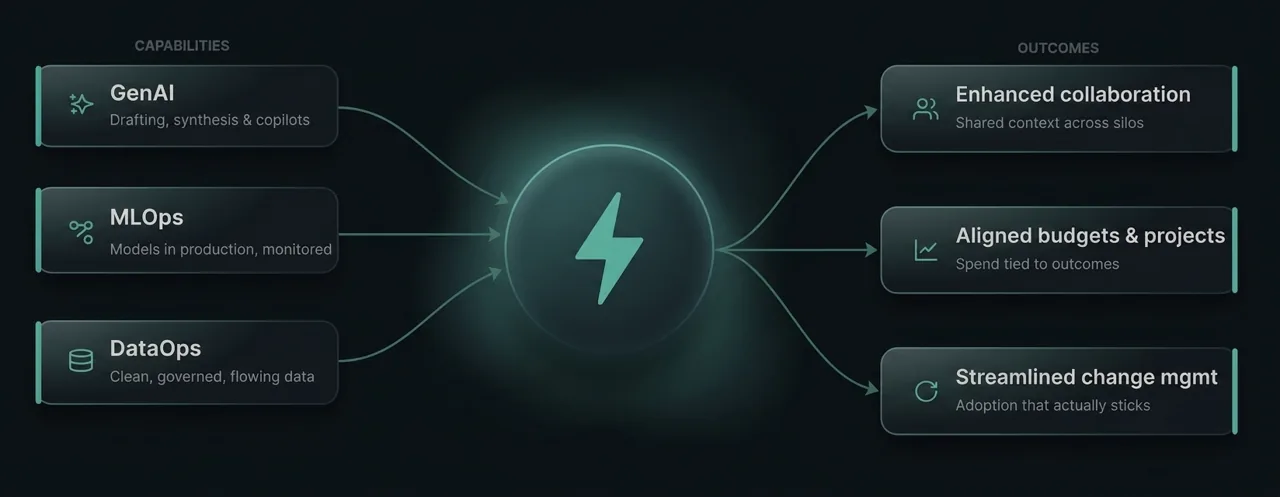
- Enhancing collaboration: AI-driven tools unify platforms, providing teams with real-time data and insights, tearing down silos and enabling seamless cross-functional collaboration.
- Aligning budgets and projects: Unified data access allows departments to synchronize budgets and project plans, not just reducing overlaps and inefficiencies but also uncovering hidden synergies. This alignment ensures optimal resource allocation and boosts productivity.
- Streamlining change management: The seamless integration of these tools into existing workflows reduces the friction typically associated with change management, making transitions smoother and less disruptive.
Enhancing Omnichannel Experiences for HCPs and Teams
The beauty of these AI-driven solutions is that they're not just improving the HCP experience through personalized, consistent interactions across multiple channels (a concept known as omnichannel engagement); they're also enhancing the employee experience within pharma organizations.
For Healthcare Professionals
- Personalized content delivery: Generative AI creates personalized content to meet HCPs' specific needs, acting as a "customer-enablement co-pilot." This empowers marketers and reps with on-demand insights for more impactful interactions (Shah et al., 2024).
- Omnichannel engagement: AI ensures HCPs receive information through their preferred channels, be it email, apps, webinars, or in-person, creating a seamless and consistent experience.
- Shifting from push to pull: Traditional omnichannel engagement relies on "push" channels which can add to HCPs' digital fatigue. AI shifts this approach to a more customer-centric "pull" model, where HCPs access information based on their needs.
With personalized content, intuitive search features, and timely recommendations, AI enables HCPs to find relevant resources on demand, reducing digital fatigue and enhancing engagement by respecting their time and preferences. This not only strengthens relationships but also improves the dissemination of critical information that can impact patient care.
For Employees
- Automation of repetitive tasks: Generative AI automates tasks like data entry, report generation, and routine communications, reducing administrative burdens.
- Enhanced strategic focus: With less time spent on manual data entry due to automated data ingestion processes, employees can focus on analyzing insights, collaborating with colleagues, and driving strategic initiatives.
- Microlearning for continuous development: AI delivers bite-sized, just-in-time training modules directly in workflows, ensuring relevant and effective learning.
Michael L. Shaw, co-lead of ZS Associates' compliance, privacy, and risk practice, envisions:
"Imagine AI personalizing a field rep's training by analyzing their weekly schedule, delivering relevant micro-training podcasts during their commute or surfacing key policy pieces before client meetings." (ZS Associates, 2024)
By leveraging AI to handle tedious tasks, these tools free up employees' time for collaboration and more strategic, value-adding activities. This shift aligns with the broader industry trend of moving away from "transactional ad hoc customer care" to a more "deliberate holistic" approach, says Chetak Buaria, VP Global Commercial Operations, Merck Group (Reuters Events Pharma, 2023), where technology enables personalized, efficient, and responsive support for both HCPs and patients.
The Potential Impact on Commercial Operations
The impact of these technologies on commercial operations could be transformative. McKinsey estimates that generative AI alone could generate $18 billion to $30 billion in annual value for pharmaceutical commercial functions (Shah et al., 2024). This includes:
- Enhanced customer engagement: Generative AI can create personalized content and recommendations tailored to individual healthcare consumers, revolutionizing pharmaceutical marketing and engagement strategies.
- Optimized sales operations: AI can provide sales representatives with real-time, contextual information, helping them navigate complex interactions more effectively. (I dig into exactly how this plays out in the field in my pieces on how AI transforms pharma sales training and the AI pharma field rep playbook.)
- Improved market analysis: Generative AI can analyze vast amounts of data to provide deeper insights into market trends, patient needs, and competitive landscapes.
Addressing Data Governance and Compliance Challenges
While the potential of these technologies is immense, their successful implementation hinges on robust data governance strategies. Unfortunately, many pharma companies are still stuck at the station when it comes to data governance, while the AI train is already racing down the track. A recent IQVIA survey found that "only 31% of pharma companies have a fully implemented data governance strategy, leaving nearly 70% with either a partial strategy or none at all" (Badhrinarayanan, 2024).
This lack of governance poses significant risks, including data quality issues, security vulnerabilities, and compliance challenges. As Gartner (2024) stated, "Without trusted data, even the best of models and algorithms will fail to deliver results" (as cited in Badhrinarayanan, 2024).
Key steps to improve data governance include:
- Establishing clear data ownership and accountability
- Implementing robust data security measures
- Ensuring compliance with evolving regulations
- Fostering a culture of data stewardship
As Kari Miller from IQVIA notes:
"There are over 101,000 global regulations and reference documents. Each year, over 8,000 new regulations and reference documents are published." (Miller, 2024)
AI can help navigate this complex landscape more efficiently, ensuring that compliance is maintained without sacrificing agility.
The Shift Away from Legacy SaaS Systems
As AI technologies advance, legacy Software-as-a-Service (SaaS) systems are struggling to keep up. This trend is exemplified by Klarna's decision to discontinue its use of Salesforce and Workday in favor of a more AI-focused approach. Klarna CEO Sebastian Siemiatkowski confirmed that the company has "used AI in-house to create a more 'agile' technology stack and no longer needs the two providers" (Kelly, 2024).
Fractal Software (2023) observed:
"Entrenched legacy providers face an uphill battle to modernize. Their aging architectures often intrinsically lack the flexibility needed to tightly integrate new capabilities. Retrofitting AI into these systems can prove an arduous and expensive endeavor, while compounding technical debt even further."
This insight aligns with Klarna's strategy to consolidate SaaS providers and focus on harnessing AI for improved efficiency.
The lock-in effect that once benefited legacy SaaS providers is now becoming a liability, as integrating newer solutions is often hindered by rigid data governance policies embedded within these aging systems. This challenge is highlighted by Salesforce CEO Marc Benioff's concerns about Klarna's decision, questioning:
"How is he managing and sharing this information? How is he achieving compliance, governance of his company? What is his institutional memory?" (Kelly, 2024)
To remain competitive, SaaS providers may need to proactively embrace change. As IT budgets shift toward more innovative solutions, legacy applications risk being left behind. Similarly, to fully leverage generative AI, MLOps, and DataOps, pharma companies need to rethink their data architectures and adopt more modular, interoperable systems for seamless data flow and integration, potentially mirroring Klarna's strategy.
Conclusion
The fusion of generative AI, MLOps, and DataOps provides pharma with a powerful tool to defragment operations and drive value. But it's not just about the tech; it's about having the right talent and a culture of data governance.
"More than anything else, digital transformation requires talent. In fact, putting together the right team of technology, data, and process people who can work together, with a strong leader who can drive change, may be the most important step a digital transformation company can take. Of course, even the best talent does not guarantee success. But the lack of it almost guarantees failure." (Davenport and Redman, 2020; p. 1)
To succeed, pharma companies need more than just data scientists and ML engineers; they need "translators" who bridge the gap between business needs and technology, ensuring AI initiatives drive strategic priorities and create true value. More on this in my next article: why the right digital talent matters in pharma.
An earlier version of this article first appeared on LinkedIn.
References
- Badhrinarayanan (IQVIA). (2024, February 27). Navigating the data deluge through data governance [Blog post]. iqvia.com
- DataKitchen. (2020). What is DataOps? datakitchen.io
- Davenport, T. H., & Redman, T. C. (2020). Digital transformation comes down to talent in 4 key areas. Harvard Business Review, 88(10), 1–8. hbr.org
- Fractal Software. (2023). State of Vertical SaaS 2023. fractalsoftware.com
- Grogan, K. (2024, September 16). How Sanofi is embracing AI in everyday operations. In Vivo. invivo.pharmaintelligence.informa.com
- Kelly, R. (2024, September 13). "How is he doing this?" – Marc Benioff questions Klarna CEO's move to scrap Workday, Salesforce in SaaS 'consolidation' drive. ITPro. itpro.com
- Miller, K. (2024, June 19). The impact of generative AI in quality management. IQVIA. iqvia.com
- Reuters Events Pharma. (2023, November 15). Drive a new wave of patient and HCP care with generative AI [Video]. YouTube. youtube.com
- Shah, B., Viswa, C. A., Zurkiya, D., Leydon, E., & Bleys, J. (2024, January 9). Generative AI in the pharmaceutical industry: Moving from hype to reality. McKinsey & Company. mckinsey.com
- ZS Associates. (2024, January 23). ZS Panel: How pharma compliance teams can leverage AI [Video]. Vimeo. vimeo.com

Written by
Frank Eisenlohr
Founder, Digital4Health · Digital Health & Pharma Consultant
Frank Eisenlohr brings 20+ years in healthcare digital transformation — advising hospitals, pharma and medtech, and building privacy-by-design platforms like a Swiss e-prescription system.
Pharma Transformation · 1/2
Related services
Turn these ideas into a working system.
This is the thinking behind my Pharma Commercial AI Transformation work — or book a potential check to talk it through.