
AI in Pharma Sales · Part 1 of 2
How AI Transforms Pharma Sales Training (Part I)
How AI transforms pharma sales training: trade 3-hour modules for 6-minute pre-call microlearning that lifts reps' sales performance and HCP relevance.
Last week, I watched a pharma rep struggle through a 45-minute presentation to an HCP who clearly wasn't engaged. Meanwhile, companies like Johnson & Johnson (Ethicon, Inc.) report their reps feel more confident and see 22% increases in sales performance using 3–5 minute AI-powered training modules (Axonify, 2024, 2025). Same industry. Same HCPs. Completely different results.
What if there was a different way?
Imagine this: Sarah Martinez, a pharma field rep, walks into Dr. Thompson's cardiology practice knowing exactly what he's been researching lately. Not because she's psychic, but because an AI system analyzed his recent publication downloads and prescribing patterns to deliver a perfectly tailored 10-minute training module that morning.
This represents a fundamental shift away from the "spray and pray" approach that has dominated pharma sales training for decades. This evolution is a critical component of a successful omnichannel strategy, ensuring that every interaction, across every channel, is informed, consistent, and valuable to the Healthcare Professional (HCP). AI-powered microlearning is a prime example of how the revolutionary AI applications I discussed in Supercharge Pharma Operations with AI! directly improve the effectiveness of our field teams and the success of our broader omnichannel strategies.
The Billion-Dollar "Training as Usual" Problem
Let's be honest. How much of your last big national sales meeting or extensive training session do your field teams really remember and use effectively? Traditional training methods, often involving lengthy, infrequent events, are struggling to keep up. Research highlights a stark reality: traditional pharmaceutical training yields only about 15% retention rates, with employees forgetting 50% of information within 1 hour and 70% within 24 hours (Helyon, 2024; eLearning Industry, 2025). Your field staff sit through week-long conferences, memorize hundreds of slides, then watch this knowledge evaporate due to the well-documented forgetting curve. This means significant training investments often disappear into thin air.
This isn't just inefficient; it's a barrier to effective omnichannel engagement. If field teams aren't equipped with the latest, most relevant information tailored to individual HCP preferences and their journey across various touchpoints, the promise of a seamless, personalized experience breaks down.
The AI-Powered Solution: Microlearning Meets Intelligence
Why 3-Minute Modules Outperform 3-Hour Sessions
While many are still in strategy meetings discussing the future of pharma sales training, forward-thinking companies have already moved beyond the chatter. They're embracing AI-powered microlearning and Just-in-Time (JIT) training, leveraging the rich HCP data often sitting in CRM systems like Veeva CRM, IQVIA OCE, or Salesforce Life Sciences Cloud.
Recent research across multiple studies shows microlearning outperforms traditional training by 143%: that's not a typo. Companies implementing microlearning see completion rates jump from 20% to 94%, meaning nearly all employees actually finish their training instead of dropping out halfway through (International Journal Research, 2025; Vouch, 2025). Meanwhile, knowledge retention rates improve from 10% with traditional methods to 65–80% with microlearning approaches (TrainingFolks, 2024).
| Hyper-Targeted | Each module is a surgical strike on a single knowledge gap, instead of hour-long lectures. AI delivers a 5-minute module on a specific clinical study or objection-handling technique. |
| Contextually Relevant | Training is triggered by real-world data from your CRM. The system uses context from HCP interactions to deliver a personalized training module to the rep before the next meeting. |
| Immediately Applicable | Learning is designed for immediate use. Modules are structured around a "Clinical Consultation Framework" to directly shape the next HCP conversation. |
| Continuously Adaptive | This is a living system. The AI analyzes engagement patterns and outcomes to constantly refine and improve the training modules, creating a self-reinforcing learning loop. |
How AI-powered microlearning and just-in-time training work for pharma sales reps.
Microlearning: It isn't simply chopping up your existing PowerPoint into pieces (that's what I call "death by a thousand cuts"). True microlearning delivers content in short, focused bursts, typically 3–5-minute modules, each designed to achieve a specific, actionable learning outcome in digestible "learning nuggets".
Just-in-Time (JIT) Training: This strategy centers on providing these learning resources precisely when and where they are needed: right before an HCP meeting, when facing an unexpected question, or when new clinical data drops. It's about reinforcing knowledge and ensuring practical application in real-time.
The Competitive Advantage Hiding in Your CRM
The real magic happens when Artificial Intelligence is applied to the wealth of HCP data residing in your CRM and other sources. Modern systems go far beyond basic CRM data, processing individual performance metrics, call recordings, manager feedback, and HCP communication patterns and even broader market trends to identify precise knowledge gaps and learning opportunities in real time (Quantified AI, 2025).
This isn't just demographic segmentation, it's behavioral prediction. The AI uses these insights to automatically generate and deliver the right just-in-time module through a modern Learning Experience Platform (LXP). This isn't just about efficiency: it's about creating a competitive advantage. Companies that master this are building an "Adaptation Advantage": the ability to update their entire field force's knowledge in days, not months, when market conditions change.
The New Paradigm: Training in Moments, Not Marathons
The new paradigm isn't about changing how a great salesperson thinks, they have always been customer-focused. The revolution is in changing how we train, moving from infrequent, hour-long presentations to delivering knowledge in 3–10 minute, high-impact "training nuggets".
This shift is delivered through a highly structured 10-Minute Pre-Call Blueprint that combines 6 minutes of learning content with 4 minutes of contextual intelligence, preparing a rep for a specific meeting:
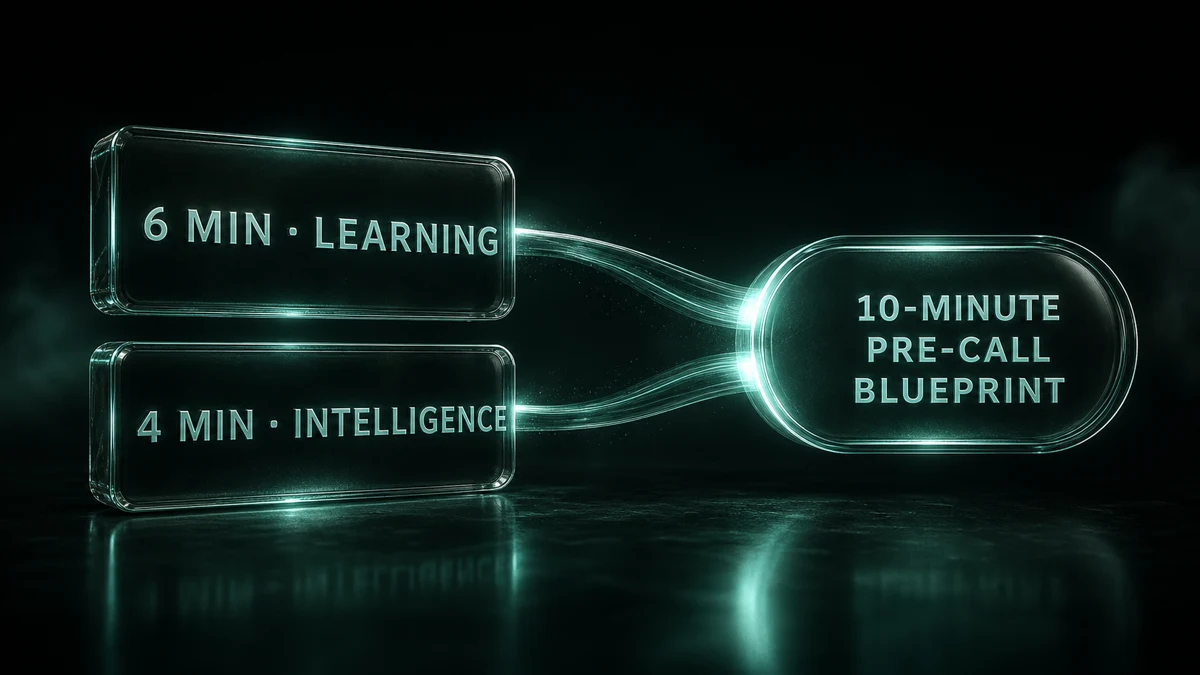
The Clinical Consultation Framework: The 6-minute learning content follows how HCPs think about patient care: Patient Population → Clinical Evidence → Treatment Application, transforming sales pitches into consultative discussions.
The Innovation: Unlike static microlearning modules, this entire blueprint is dynamically generated by AI for each specific HCP interaction, delivering personalized content tailored in real-time to optimize each meeting.
Real-World Impact: The Numbers Don't Lie
This isn't just theory. Leading pharmaceutical companies are seeing remarkable results.
Performance Gains
- Johnson & Johnson's Ethicon achieved a 49% knowledge boost across over 1,000 field representatives through AI-powered microlearning (Axonify, 2024)
- Pharmaceutical industry analysis shows AI driving reps increases from 1.5% to 3.5%, 100% improvement in new hire retention rates, and 22% increases in sales performance following microlearning implementations (Quantzig, 2025)
- Medical Science Liaison programs demonstrate 94% positive student reactions and 82% successful knowledge acquisition using microlearning approaches (JMIR Medical Education, 2023)
- Compliance training shows 130% increases in both employee engagement and productivity compared to traditional methods (Multiple Industry Studies, 2024–2025)
Cost-Effectiveness Advantages
Recent research demonstrates compelling financial benefits:
- 50% lower development costs and 300% faster development speed (Multiple Industry Studies, 2024–2025)
- $30 return for every $1 invested in microlearning programs (IBM Research, 2024)
- 40–60% reduction in time-to-competency versus traditional classroom training (Corporate Learning Research, 2025)
- Training time reduction from 6–8 weeks to 4 weeks for pharmaceutical onboarding (Corporate Learning Research, 2025)
Strategic Advantages: The AI Flywheel
The evidence is clear, but the real competitive advantage lies in the AI flywheel you're building. This creates two compounding effects:
Omnichannel Cohesion: Field staff equipped with insights from every digital touchpoint ensure in-person conversations seamlessly reinforce your entire marketing strategy.
| Benefit Category | Implementation Description | Omnichannel Performance Impact |
|---|---|---|
| Knowledge Foundation | Targeted, HCP-specific content is digestible | Field staff equipped for relevant interactions across all channels |
| Enhanced Engagement | Interactive formats (videos, quizzes, simulations) | Higher completion = better-prepared reps with consistent messaging |
| Agility & Speed | On-demand mobile learning with rapid updates | Teams adapt quickly, ensuring consistent omnichannel messaging |
| Channel Consistency | AI aligns training with broader HCP journey insights | Field interactions reinforce other customer touchpoints |
Benefits of AI-powered microlearning for pharma sales and omnichannel customer engagement success.
Network Effect: Every interaction makes the AI smarter, continuously refining personalization. Early adopters build a compounding competitive advantage that becomes exponentially harder for competitors to match.
While competitors struggle with static training, your system learns and improves with every interaction.
Then → Now: how fast this moved
When I first published this in 2025, AI-generated pre-call microlearning was still the early-adopter edge: most field teams were debating whether to pilot it. By 2026 it has become table stakes: the LXPs and CRMs have native generative layers, and the question has shifted from "should we?" to "why aren't our reps already getting an AI-synthesised brief before every call?" That is the exponential pace of AI in a single year: the gap between teams who operationalised it and those still in strategy meetings widened far faster than the retention curves above. The numbers in this article still hold; the window to build the flywheel before everyone else does has narrowed.
Coming Up in Part 2
We'll move from the "why" and "what" to the "how." I'll lay out a practical blueprint for implementing AI-powered microlearning in your organization, focusing on leveraging Salesforce data, navigating common challenges, and measuring the true ROI of this transformative approach, in The AI Pharma Field Rep Playbook (Part II).
An earlier version of this article first appeared on LinkedIn.
References
- Axonify (2024). Ethicon customer story. axonify.com/customer-stories/ethicon
- eLearning Industry (2025). Microlearning statistics, facts and trends for 2025. elearningindustry.com/microlearning-statistics-facts-and-trends
- Helyon (2024). Microlearning boundaries: A systematic review and analysis. sciencedirect.com
- International Journal Research (2025). The effects of microlearning on EFL students' English speaking: A systematic review and meta-analysis. ijter.com
- JMIR Medical Education (2023). Digital microlearning for training and competency development of older adult care personnel. mededu.jmir.org
- Quantified (2025). The AI and innovation are reshaping pharma sales training in 2025. quantified.ai/blog
- Quantzig (2025). Sales force effectiveness: A key to pharma's 3.5% RoI gain. quantzig.com/case-studies/sales-force-effectiveness
- TrainingFolks (2024). Microlearning insights: healthcare & pharma. trainingfolks.com/blog
- Vouch (2025). 13 eye-opening microlearning statistics for 2025. vouchfor.com/blog/microlearning-statistics
Written by
Frank Eisenlohr
Founder, Digital4Health · Digital Health & Pharma Consultant
Frank Eisenlohr brings 20+ years in healthcare digital transformation — advising hospitals, pharma and medtech, and building privacy-by-design platforms like a Swiss e-prescription system.
AI in Pharma Sales · 1/2
Related services
Turn these ideas into a working system.
This is the thinking behind my AI Sales Enablement for Pharma work — or book a potential check to talk it through.