
Healthcare Fragmentation · Part 3 of 3
Defragmenting Healthcare: My Strategy Blueprint
How to fix healthcare fragmentation in practice: my blueprint of five technology commandments, aligned KPIs and budgets, the right culture, and leadership.
Healthcare fragmentation drives up costs and lowers the quality of care. In my first article, Fixing Healthcare Fragmentation, I explored why fragmentation matters so much. In the second, Fragmentation in Healthcare: Who's to Blame?, I examined how hospitals, physicians, patients, and pharmaceutical companies all contribute to the problem.
Now, in this final installment, I want to move from diagnosis to action. This is my personal perspective on how to fix healthcare fragmentation and build a more sustainable healthcare system.
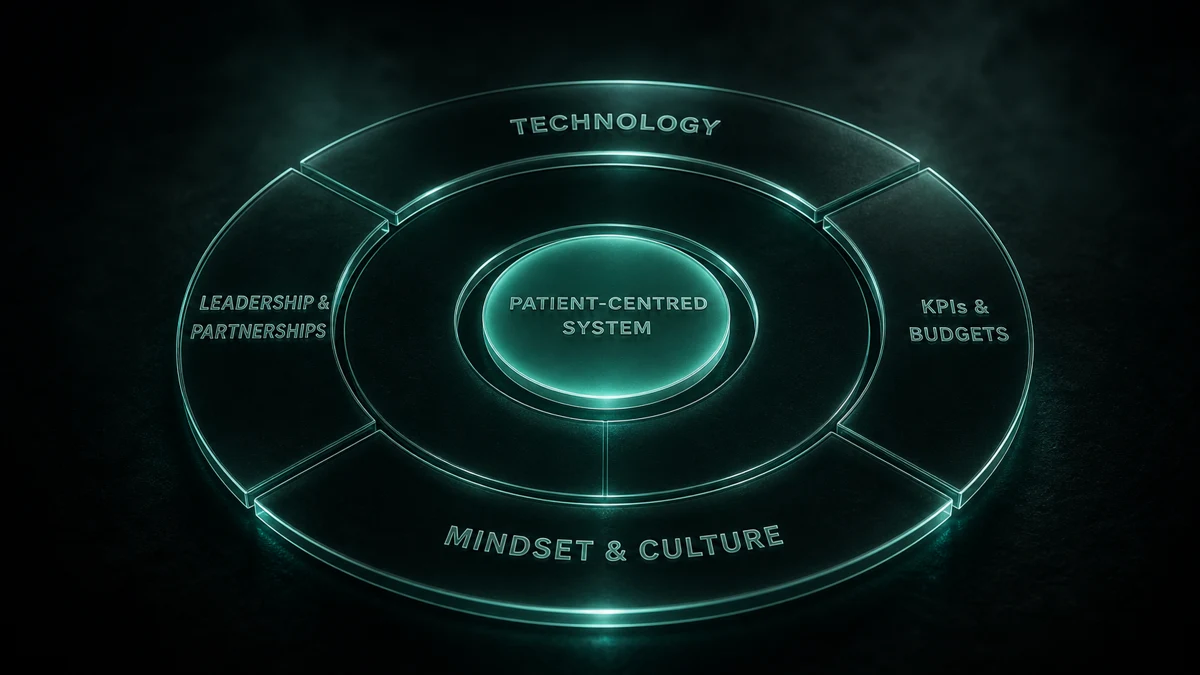
I'll start with a reality check on the limitations of technology, offer my five commandments for using technology strategically to foster collaboration, explain the importance of aligning short-term KPIs and budgets with a shared long-term vision, and discuss cultivating the right mindset and culture. Ultimately, I'll conclude that change begins with each one of us, and I'll challenge you to reflect on your own role within the healthcare ecosystem.
1. Moving Beyond Interoperability: Why Technology Alone Can't Save Us
Let's face it: much of the fragmentation we experience day in, day out is actually caused by the technology we've come to love, rely on, and continue to pin our hopes on. Interoperability is the buzzword of the moment, and even the Swiss Federal Office of Public Health (FOPH) plans to throw a staggering 400 million francs at the problem (Bignens, 2024), mirroring the U.S., which has already spent "tens of billions of dollars trying to encourage doctors and hospitals to adopt electronic health records" (Kellermann & Jones, 2013). Yet the expected benefits remain elusive and the core problems unresolved. A Guidehouse (2024) report highlights that 75% of healthcare providers increased their digital and IT budgets from 2019 to 2023, but integration challenges remain. Similarly, a McKinsey study found that data fragmentation remains a costly problem, consuming 20–25% of US healthcare spending (Boyden, 2023).
These findings show that the real issues lie deeper: in misaligned incentives, siloed operations, and a focus on short-term gains over long-term sustainability. As Alexander Zimmer aptly puts it:
The overemphasis on technical aspects can hinder collaboration if not properly embedded in the organizational context. Technology alone is not enough to overcome fragmentation. (Zimmer, 2023)
This perspective is further supported by Vivek Subbiah, MD, in his article "Fragmentation in Medicine Harms Patients and Hinders Research," where he asserts that technological advances, while beneficial, have also inadvertently contributed to fragmentation by fostering isolated subspecialties and siloed practices (Subbiah, 2024).
Now that we've established that technology alone isn't the cure, let's look at what it can actually do for us when used wisely.
2. Using Technology to Fight Fragmentation and Encourage Collaboration
Often viewed as a simple "enabler" for transformation, technology can become a much more powerful tool for change if deployed correctly within organizations.
My 5 Commandments for Using Technology to Drive Change
- Minimize email use. This may seem counterintuitive at first. However, every email we send creates a new silo of information that only the recipient can access. Blocking internal email and using it only for external communication can be a transformative approach. Companies like Atos have implemented "zero email" policies, replacing emails with collaborative tools to increase efficiency and knowledge sharing (Chhabra & Sharma, 2018). Recent research shows that excessive email communication can lead to technology overload and reduced productivity (Rasool et al., 2022). In my experience, internal emails often lead to duplicated efforts and miscommunication. When leading a project team, we found that important decisions buried in email threads were missed by new team members. By reducing our reliance on email and using collaborative platforms instead, we made information accessible and improved team alignment.
- Post by default. Instead of emailing, I engage with colleagues around projects and accounts in channels on Teams. This approach makes information discoverable and searchable for everyone, sparks ideas, and encourages collaboration across departments (Montrief et al., 2020). In one case, it allowed a colleague from another department to contribute a solution to our problem simply by observing an open channel discussion.
- Open access policy. I encourage team members to provide access to their files on projects, accounts, and even personal goals or KPIs to promote transparency and break down barriers. For example, by openly sharing project roadmaps, we've been able to identify overlapping efforts and consolidate resources, saving both time and budget. Open collaboration platforms like Slack have been shown to improve knowledge sharing and facilitate cross-functional teamwork, enabling more efficient project execution (Tomlinson et al., 2023).
- Avoid Excel silos. While Excel excels at calculations, it is not meant for collaborative, dynamic data management. Using Excel to manage account information, track projects, or monitor KPIs is inefficient and error-prone, requiring manual updates and re-entry across multiple spreadsheets and systems. Instead, leverage your existing SaaS tools like CRM or project management systems. But I know what you're thinking: "These systems don't provide the specific capabilities my team needs on a daily basis." That's where agile solutions like Microsoft Dataverse or Fabric come in. They build on existing data, enrich it, and add the specific capabilities you need for collaboration and automation, effectively eliminating Excel silos and increasing productivity.
- Use AI for patients and physicians. Patients often face "expertise asymmetry," where physicians know more because they have more information. AI tools can help bridge this gap by facilitating communication and ensuring patients are actively engaged in their care (Wójcik et al., 2023). Dr. Markus Vogel, Chief Medical Information Officer at Microsoft, emphasizes that AI-driven documentation solutions like Nuance's Dragon Medical One not only reduce physicians' administrative burdens but also allow them to dedicate more time to patients, enhancing care quality and trust (Mirza, 2024).
Then → now (2026): When I first wrote this blueprint, "use AI for patients and physicians" was the forward-looking commandment: ambient documentation and patient-facing chat assistants were promising pilots. Two years later they're routine: ambient scribes are deployed across major health systems, and clinical-grade large language models have moved from demo to default. The pace has been genuinely exponential. That makes the rest of this blueprint more urgent, not less. AI now removes the old excuse that "the technology isn't ready", so the binding constraints are exactly the ones the other four sections cover: incentives, mindset, and leadership. Better tools applied to a fragmented system just produce faster, more confident fragmentation.
3. Aligning Short-Term KPIs, Budgets, Long-Term Vision and Sustainability
Breaking out of fragmentation is all about connecting our day-to-day goals and ways of working with a broader vision. John Halamka, MD, MS, President of Mayo Clinic Platform, and Micky Tripathi, National Coordinator for Health Information Technology, put it well in their article "The HITECH Era in Retrospect":
We need to think about healthcare as an ecosystem, not a collection of independent actors. Every decision we make should consider its impact on the entire system, not just our immediate objectives. (Halamka & Tripathi, 2019)
In my experience, you don't have to abandon your short-term KPIs to make a system-wide impact. Instead, start by aligning them with the bigger picture, whether within your department, your organization, or even with your competitors. At one company I worked with, each department's separate budget for digital solutions led to multiple disconnected initiatives. Aligning and collaborating on those projects could have created significantly more value than each project alone.
Mitchell (2019), in his publication "Fighting Fragmentation in Healthcare: A Modest Proposal" from the Rotman School of Management, echoes this concern:
Individual actors commonly make decisions that are best for their own goals and budgets … but are far from optimal for the health system as a whole. […] The fragmentation of budgets within and across organizations inhibits systemic decisions because those who must pay for products and services that provide systemic gains often do not reap the benefits. (Mitchell, 2019)
Even where, as Mitchell notes, this is often not the case, those investing in systemic solutions can, and often will, also benefit from those systemic gains. Here's how I see it: aligning budgets isn't about spending more, it's about spending smarter. It not only helps you hit your KPIs but also makes things easier for everyone down the line. So instead of viewing conversations with colleagues or even competitors as a nuisance, see them for what they really are: essential collaboration.
What do you think? Have you seen examples of budget alignment making a difference in your work? Leave me a comment below.
4. Cultivating the Right Mindset and Culture
Changing technology and KPIs is not enough; mindset and culture play a crucial role.
- Nobody wants to steal your idea. Talk openly about your ideas and projects. Don't be afraid that someone might steal one. Once I started sharing my concepts openly, I found that feedback from others helped refine them and gain support for implementation.
- Don't be afraid of transparency. Transparency about projects, accounts, activities, and KPIs across the organization uncovers hidden synergies and is the first step toward becoming more efficient and impactful.
- Use "and" instead of "but". Is "but" the first word you say when a colleague approaches you with a new idea? Start practicing "yes, and" thinking, which builds on ideas instead of shutting them down. This approach makes innovation possible.
- Move out of your comfort zone. Change can be uncomfortable, but it's necessary for growth. I encourage team members to take on new challenges and support them through the learning curve.
- Nothing is impossible. "It's always been this way" doesn't mean it can't be done differently today. Especially when it comes to changing processes, systems, or tools, almost anything is possible now. I've seen legacy systems replaced with more efficient solutions despite compliance and data governance, because we actually can.
- Keep learning. Learning something new gives you a fresh perspective and enables you to do things differently. I make it a point to stay updated on industry trends, and I encourage my team to do the same.
5. Leadership and Partnerships: Driving Systemic Change
As much as I admire bottom-up initiatives, they ultimately fail if not endorsed, or even mandated, from the top. Believe me, I've been there. "Leaders play a crucial role in breaking down silos, fostering collaboration, and integrating diverse perspectives" (Trigyn, 2024).
Without executive support, organizations are likely to continue operating in their comfort zones, preventing or at least slowing the digital transformation they seek.
What should leaders do?
- Set a compelling vision. Have a clear vision for your company and communicate it consistently. In my experience, when leaders articulate a compelling vision, it motivates the entire organization.
- Implement the five commandments. By adopting these principles, leaders can drive collaboration and break down silos.
- Encourage and reward innovative ideas. Recognize ideas that address systemic issues and challenge the status quo. I've seen teams become more proactive when their innovative efforts are acknowledged.
- Initiate partnerships. Work with other healthcare organizations to tackle shared challenges. By pooling resources, knowledge, and expertise, we become stronger together, creating solutions that no single entity could achieve alone.
- Provide training. Support staff in adapting to new ways of working. Offering training programs ensures everyone is equipped to contribute effectively.
6. Change Starts with Each One of Us: Questions to Reflect On
Change is challenging and sometimes uncomfortable, but it's essential if we want to move forward. Below are some questions I've encountered in my professional and personal interactions within the healthcare system. These are not meant to criticize but to stimulate reflection on how we can all contribute to a more integrated, systemic, and patient-centered approach. I'm interested in hearing your thoughts: how do they resonate with you?
For healthcare professionals and providers
- Are your consultations or treatment plans guided by what's best for the patient's long-term health, or influenced by short-term KPIs, time and budget constraints, or reimbursement?
- Are the projects you're involved in creating additional data silos, or are they promoting high-quality, integrated care across departments and providers? Well-meant actions may have unintended consequences.
- Did you think of a sustainable business model, or do you rely on continuous external funding?
For pharmaceutical and medical device companies
- Do your colleagues know what you're working on, even if they're not directly involved? Sometimes the most valuable synergies arise from unexpected corners of the organization.
- Before defaulting to what has always worked, like producing standard marketing material or medical education sessions, could your budget be used to change the system for the better, generate more ROI in the long run, and make life easier for those who follow?
- When sponsoring or granting funds, do you ensure they aren't fueling stand-alone, one-off solutions or events, and that they remain viable and desirable even after you've moved on?
For payers
- How aligned are your financial incentives with patient outcomes and overall system efficiency? For example, is therapy for patient mobility also empowering patients long after discharge?
For patients
- Are your doctor visits driven by genuine medical needs, or by the need to get your money's worth?
- Do you delegate your health to doctors, therapists, and nurses, or take responsibility for it?
- Are you simply seeking quick fixes, or taking care of yourself so as not to get sick in the first place?
- Before considering elective surgery, are you exploring all conservative treatment options first?
- Are you educating yourself about your disease and treatment?
7. Conclusion: A Call to Action
Defragmenting healthcare is a complex challenge, but it's not insurmountable. By aligning incentives, embracing change, and fostering collaboration across all stakeholders, we can create a more integrated, efficient, and patient-centered healthcare system.
As I've shared in Fixing Healthcare Fragmentation and Fragmentation in Healthcare: Who's to Blame?, understanding the problem is just the first step. Implementing this strategy blueprint requires the courage to challenge the status quo, a vision that sees beyond immediate gains, and a commitment to work together for systemic change.
Change begins with each one of us. Let's connect the dots, piece by piece, to create the healthcare system we all envision. Together, we can make a lasting impact, benefiting patients, providers, and our organizations.
If you're working on stitching a fragmented system back together, this is exactly the work I do day to day: see my healthcare interoperability consulting and let's talk.
An earlier version of this article first appeared on LinkedIn.
References
- Bignens, S. (2024). Serge Bignens on Swiss e-health and interoperability investment.
- Boyden, J. (2023). Data fragmentation in healthcare: Costs and consequences. McKinsey & Company.
- Chhabra, L., & Sharma, S. (2018). Organizational e-mail communication and its perception as a barrier to communication and collaboration across hospital-based health care professions. Journal of Organizational Change Management, 31(1), 132–146. https://doi.org/10.1057/s41266-018-0033-y
- Guidehouse. (2024). 2024 Health system digital and IT investments. https://guidehouse.com/insights/healthcare/2023/2024-health-system-digital-and-it-investments
- Halamka, J. D., & Tripathi, M. (2019). The HITECH era in retrospect. New England Journal of Medicine, 380(17), 1573–1576. https://doi.org/10.1056/NEJMp1901229
- HealthManagement.org. (2023). Information asymmetry in healthcare: How to bridge the gap? https://healthmanagement.org/c/imaging/News/information-asymmetry-in-healthcare-how-to-bridge-the-gap
- Kellermann, A. L., & Jones, S. S. (2013). What it will take to achieve the as-yet-unfulfilled promises of health information technology. Health Affairs, 32(1), 63–68. https://doi.org/10.1377/hlthaff.2012.0693
- Mirza, M. (2024). Microsoft's innovative AI solution transforms the doctor-patient relationship. https://dieurope.com/microsofts-innovative-ai-solution-transforms-the-doctor-patient-relationship/
- Mitchell, W. (2019). Fighting fragmentation in healthcare: A modest proposal. Rotman School of Management. https://hbsp.harvard.edu/product/ROT383-PDF-ENG
- Montrief, T., et al. (2020). Using collaborative tools for efficient knowledge sharing in healthcare. Journal of Medical Communication.
- Rasool, S. F., et al. (2022). Excessive email communication and its impact on productivity: A systematic review. Journal of Information Technology Management.
- Subbiah, V. (2024). Fragmentation in medicine harms patients and hinders research. Nature Medicine. https://doi.org/10.1038/s41591-024-03194-1
- Tomlinson, S., et al. (2023). Improving knowledge sharing with open collaboration platforms like Slack. Journal of Healthcare Collaboration.
- Trigyn. (2024). Role of leadership in driving digital transformation. https://www.trigyn.com/insights/role-leadership-driving-digital-transformation
- Wójcik, S., Rulkiewicz, A., Pruszczyk, P., Lisik, W., Poboży, M., & Domienik-Karłowicz, J. (2023). Beyond ChatGPT: What does GPT-4 add to healthcare? The dawn of a new era. Cardiology Journal, 30(6), 1018–1025. https://doi.org/10.5603/CJ.a2023.0050
- Zimmer, A. (2023). Vernetzte Digitalisierung. Schweizerische Ärztezeitung, 104(41), 28–30. https://doi.org/10.4414/saez.2023.1264349127

Written by
Frank Eisenlohr
Founder, Digital4Health · Digital Health & Pharma Consultant
Frank Eisenlohr brings 20+ years in healthcare digital transformation — advising hospitals, pharma and medtech, and building privacy-by-design platforms like a Swiss e-prescription system.
Healthcare Fragmentation · 3/3
Related services
Turn these ideas into a working system.
This is the thinking behind my Healthcare Interoperability Consulting work — or book a potential check to talk it through.